Lehigh University Athletics
Five Years Later: Jordan Hamilton
3/16/2017 11:57:00 AM | Men's Basketball, Student Athlete, Features
#LehighBeatDuke Oral History
By: Justin Lafleur, Lehigh Sports Communications
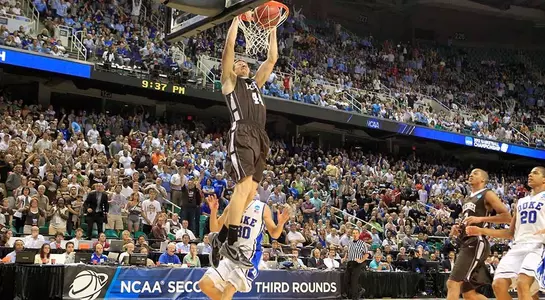
Jordan Hamilton was a co-captain of the 2011-12 Lehigh men's basketball team that earned a historic win over Duke in the NCAA Tournament.
Today, Hamilton is applying to graduate school where he looks to study positive organizational psychology, something he began learning - and appreciating - as part of that Mountain Hawks' team.
"Positive organizational psychology is really an extension of what I learned from our experience in 2012," said Hamilton. "It focuses on the importance of developing a positive culture and what the unity of an organization can accomplish."
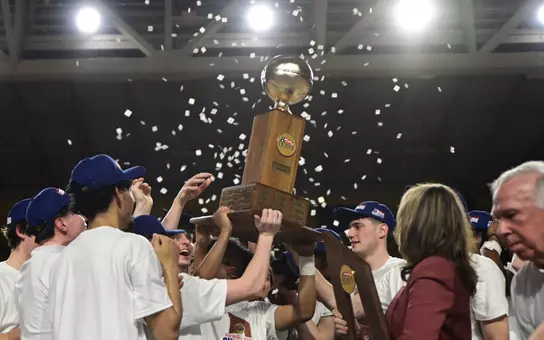
The unity of the 2011-12 Mountain Hawks helped lead to not only a Patriot League Championship, but also Lehigh's first-ever NCAA Tournament victory. To this day, Lehigh remains one of just eight No. 15 seeds to ever beat a No. 2 seed.
The team wouldn't have been successful without a player like Hamilton, a senior who knew and embraced his role. He started all 35 games for the 27-8 Mountain Hawks that season, averaging 6.5 points and 1.7 rebounds, but his impact went far beyond any statistics.

"I would say I was the glue guy, both on and off the court," said Hamilton. "I would defend, I would knock down threes, I would move the ball and I would provide energy, enthusiasm and do whatever was needed. Off the court, we really had a vision of what our culture would look like. It was my job to make sure that everyone stayed together and stayed focused on our goals."
The end result for the Mountain Hawks was a team that was together and tremendously successful (winning a school record 27 games).
It wasn't always easy. It took a lot of buy-in from the entire team, including players giving up individual statistics for the betterment of the group.
"I was the liaison between the team and Coach (Brett) Reed," said Hamilton. "I helped make sure there were clear lines of communication, keeping him informed on what the team was feeling and keeping the team informed on what he was feeling. We felt like a family amongst not only the players, but that feeling also extended to the coaches."
Everyone knew their roles; Hamilton was a perfect example.
"The buy-in didn't happen overnight," he said. "There are different turning points throughout any season. You may be bought in for the first two weeks, then you have a hard practice and you start to question things. You win your first two games, then you lose two. With all these turning points throughout the season, we continued to come together rather than falling apart."
It's probably no coincidence that Hamilton looks to study the very thing he learned on that Mountain Hawks' team. Between his undergraduate and soon-to-be days as a graduate student, he has continued his playing days by playing professionally.
After Lehigh, Hamilton signed with the Brampton A's in Canada.
"I played there for a season and a half, then suffered an injury, so I went back to Seattle and spent some time working for a startup company, an online writing platform," he said.
As Hamilton said, the platform was basically "Instagram for writing," featuring things like short stories, and poems.
"I've always liked writing and I was interested in learning about the tech application world, so I spent some time working in that role in between playing opportunities," he said.
The seeds of Hamilton's next opportunity were planted when he wasn't expecting it. Hamilton reconnected with former Lehigh teammates at The Tournament, a summer tournament featuring alumni of former college teams who play for the championship and end prize of $1 million (that prize has since been increased to $2 million in subsequent tournaments).
"At that time, I was on the fence whether I wanted to keep playing or not," said Hamilton. "I go out, play in The Tournament and end up being the leading scorer in the game for both sides. (Former Lehigh teammates) Mackey McKnight and Holden Greiner said I have to keep playing. You can make a living playing basketball."
Later in the summer, Greiner was heading to Luxembourg to play professionally. Hamilton came along and stayed with Greiner while looking for an opportunity himself.
That opportunity came.
"I ended up signing a contract with a team in Luxembourg and played there for two months, then I signed a longer contract in Germany for another five months," said Hamilton. "It lasted until the following year when I hurt my foot, so I decided I wanted to start graduate school."
From his days as a Lehigh men's basketball player, Hamilton felt well positioned for success in professional basketball.
"Coach Reed and our defensive system did a really good job of preparing me," said Hamilton. "The Patriot League is a high-IQ league. Coaches overseas seemed to like that I had played for a Patriot League team. It fits the style of play in Europe."

For all that well, some significant adjustments were needed.
"As an American player overseas, all of a sudden you're the guy. I was expected to score, rebound, dish assists and contribute more so than I had at Lehigh. But I had been training for that over the summer and I fit into that role."
Hamilton is a great example of the wide breadth of accomplishments for Lehigh men's basketball alumni in life after Lehigh. He has gotten paid to play the game he loves, and he's in a good position to succeed off the court.
"If you look at my college statistics, they're not as glamorous as other players, but I played for a very successful program, and team," said Hamilton. "That goes a long way and that means a lot to professional coaches when they're looking at players. You mention the name Lehigh and being a student-athlete from Lehigh raises eyebrows and gets people's attention."
A Political Science major at Lehigh, Hamilton, and all Lehigh student-athletes, were (and are) put through a rigorous schedule. A lot was demanded of Hamilton, and he's grateful.
"There's a lot put on the student, a lot of responsibility to take care of your own work," he said. "You develop habits of discipline and necessary focus that's unique to college sports. Ultimately, you have to figure out a way to be successful, both on and off the court. I'm grateful for my Lehigh experience because it makes other ventures seem easy. I have a model of how to be successful."
Five years ago, Hamilton and his fellow Mountain Hawks were certainly successful, defeating Duke 75-70 and shocking the world, but not themselves.
"We had an extreme amount of confidence in ourselves and one another as a unit," said Hamilton. "When you believe in something greater than yourself, that belief is exponential. That confidence continued to build throughout the season. We never felt like we couldn't beat an opponent, if we stayed together and started to find that rhythm."
"I love how Jordan brought a sense of focus and determination to our team," said Lehigh head coach Brett Reed. "This is a young man who pours himself into everything he does. His senior season was no different."
When thinking about the Lehigh men's basketball program, the win over Duke will often come to mind first, but Lehigh is about much more than that one game in March of 2012.
"Lehigh provided me an opportunity to find my own passions, to take different paths and combine what I've learned in basketball and apply those skills beyond the game," said Hamilton.
Hamilton's Lehigh playing days are over, but he still feels invested in the success of the present-day Mountain Hawks.
"I'm really proud of the program and the types of student-athletes that are continuing to come to Lehigh, high-caliber players," he said. "Lehigh is consistently right there among the best teams in the Patriot League. The program has maintained that expectation of competing for championships."
Sustained success is possible because of intangibles that make up a strong program. One intangible is a feeling of family, something that extends years, and even decades. Whether you're a current or past Lehigh player, everyone is on the same team, part of the same family, trying to help each other be as successful as possible - both on and off the court.
"A few summers ago, I had a chance to head to Lehigh and talk to some of the guys," said Hamilton. "I shared some of my insight from what I learned on how to contribute, how to lead and how to build and maintain a successful culture.
"To see how the Lehigh family extends past guys you played with, it's really special."

By: Justin Lafleur, Lehigh Sports Communications
Jordan Hamilton was a co-captain of the 2011-12 Lehigh men's basketball team that earned a historic win over Duke in the NCAA Tournament.
Today, Hamilton is applying to graduate school where he looks to study positive organizational psychology, something he began learning - and appreciating - as part of that Mountain Hawks' team.
"Positive organizational psychology is really an extension of what I learned from our experience in 2012," said Hamilton. "It focuses on the importance of developing a positive culture and what the unity of an organization can accomplish."
The unity of the 2011-12 Mountain Hawks helped lead to not only a Patriot League Championship, but also Lehigh's first-ever NCAA Tournament victory. To this day, Lehigh remains one of just eight No. 15 seeds to ever beat a No. 2 seed.
The team wouldn't have been successful without a player like Hamilton, a senior who knew and embraced his role. He started all 35 games for the 27-8 Mountain Hawks that season, averaging 6.5 points and 1.7 rebounds, but his impact went far beyond any statistics.
"I would say I was the glue guy, both on and off the court," said Hamilton. "I would defend, I would knock down threes, I would move the ball and I would provide energy, enthusiasm and do whatever was needed. Off the court, we really had a vision of what our culture would look like. It was my job to make sure that everyone stayed together and stayed focused on our goals."
The end result for the Mountain Hawks was a team that was together and tremendously successful (winning a school record 27 games).
It wasn't always easy. It took a lot of buy-in from the entire team, including players giving up individual statistics for the betterment of the group.
"I was the liaison between the team and Coach (Brett) Reed," said Hamilton. "I helped make sure there were clear lines of communication, keeping him informed on what the team was feeling and keeping the team informed on what he was feeling. We felt like a family amongst not only the players, but that feeling also extended to the coaches."
Everyone knew their roles; Hamilton was a perfect example.
"The buy-in didn't happen overnight," he said. "There are different turning points throughout any season. You may be bought in for the first two weeks, then you have a hard practice and you start to question things. You win your first two games, then you lose two. With all these turning points throughout the season, we continued to come together rather than falling apart."
It's probably no coincidence that Hamilton looks to study the very thing he learned on that Mountain Hawks' team. Between his undergraduate and soon-to-be days as a graduate student, he has continued his playing days by playing professionally.
After Lehigh, Hamilton signed with the Brampton A's in Canada.
"I played there for a season and a half, then suffered an injury, so I went back to Seattle and spent some time working for a startup company, an online writing platform," he said.
As Hamilton said, the platform was basically "Instagram for writing," featuring things like short stories, and poems.
"I've always liked writing and I was interested in learning about the tech application world, so I spent some time working in that role in between playing opportunities," he said.
The seeds of Hamilton's next opportunity were planted when he wasn't expecting it. Hamilton reconnected with former Lehigh teammates at The Tournament, a summer tournament featuring alumni of former college teams who play for the championship and end prize of $1 million (that prize has since been increased to $2 million in subsequent tournaments).
"At that time, I was on the fence whether I wanted to keep playing or not," said Hamilton. "I go out, play in The Tournament and end up being the leading scorer in the game for both sides. (Former Lehigh teammates) Mackey McKnight and Holden Greiner said I have to keep playing. You can make a living playing basketball."
Later in the summer, Greiner was heading to Luxembourg to play professionally. Hamilton came along and stayed with Greiner while looking for an opportunity himself.
That opportunity came.
"I ended up signing a contract with a team in Luxembourg and played there for two months, then I signed a longer contract in Germany for another five months," said Hamilton. "It lasted until the following year when I hurt my foot, so I decided I wanted to start graduate school."
From his days as a Lehigh men's basketball player, Hamilton felt well positioned for success in professional basketball.
"Coach Reed and our defensive system did a really good job of preparing me," said Hamilton. "The Patriot League is a high-IQ league. Coaches overseas seemed to like that I had played for a Patriot League team. It fits the style of play in Europe."
For all that well, some significant adjustments were needed.
"As an American player overseas, all of a sudden you're the guy. I was expected to score, rebound, dish assists and contribute more so than I had at Lehigh. But I had been training for that over the summer and I fit into that role."
Hamilton is a great example of the wide breadth of accomplishments for Lehigh men's basketball alumni in life after Lehigh. He has gotten paid to play the game he loves, and he's in a good position to succeed off the court.
"If you look at my college statistics, they're not as glamorous as other players, but I played for a very successful program, and team," said Hamilton. "That goes a long way and that means a lot to professional coaches when they're looking at players. You mention the name Lehigh and being a student-athlete from Lehigh raises eyebrows and gets people's attention."
A Political Science major at Lehigh, Hamilton, and all Lehigh student-athletes, were (and are) put through a rigorous schedule. A lot was demanded of Hamilton, and he's grateful.
"There's a lot put on the student, a lot of responsibility to take care of your own work," he said. "You develop habits of discipline and necessary focus that's unique to college sports. Ultimately, you have to figure out a way to be successful, both on and off the court. I'm grateful for my Lehigh experience because it makes other ventures seem easy. I have a model of how to be successful."
Five years ago, Hamilton and his fellow Mountain Hawks were certainly successful, defeating Duke 75-70 and shocking the world, but not themselves.
"We had an extreme amount of confidence in ourselves and one another as a unit," said Hamilton. "When you believe in something greater than yourself, that belief is exponential. That confidence continued to build throughout the season. We never felt like we couldn't beat an opponent, if we stayed together and started to find that rhythm."
"I love how Jordan brought a sense of focus and determination to our team," said Lehigh head coach Brett Reed. "This is a young man who pours himself into everything he does. His senior season was no different."
When thinking about the Lehigh men's basketball program, the win over Duke will often come to mind first, but Lehigh is about much more than that one game in March of 2012.
"Lehigh provided me an opportunity to find my own passions, to take different paths and combine what I've learned in basketball and apply those skills beyond the game," said Hamilton.
Hamilton's Lehigh playing days are over, but he still feels invested in the success of the present-day Mountain Hawks.
"I'm really proud of the program and the types of student-athletes that are continuing to come to Lehigh, high-caliber players," he said. "Lehigh is consistently right there among the best teams in the Patriot League. The program has maintained that expectation of competing for championships."
Sustained success is possible because of intangibles that make up a strong program. One intangible is a feeling of family, something that extends years, and even decades. Whether you're a current or past Lehigh player, everyone is on the same team, part of the same family, trying to help each other be as successful as possible - both on and off the court.
"A few summers ago, I had a chance to head to Lehigh and talk to some of the guys," said Hamilton. "I shared some of my insight from what I learned on how to contribute, how to lead and how to build and maintain a successful culture.
"To see how the Lehigh family extends past guys you played with, it's really special."
Thursday, July 02
Friday, February 06
Thursday, January 29
Wednesday, November 12